


Here are a collection of tips and tricks to get you going - Got any more tips? Do you have some personal experiences you want to share, good stuff then just write to us at support@statii.com
Thanks to TheMoo of course for making this initial page!
1. Which model?
There are obviously several different Status models available so some research is necessary to see what is best for you in the way of shape and sound. Asking questions on the Statii forum can reveal a great invaluable information, and its FREE!


2. Which neck?
Through neck or Bolt on? There are several schools of thought here. Some people think it has an effect on the sound of the bass. Others don't feel this and consider this as purely a money saving option (subjective)
Here is an S2 classic 5 string with a through-neck

Here is an S2 classic 4 string with a bolt-on neck

3. Headless or Headed? - Here is another option that is seen as purely cosmetic. The general consensus is that headed or headless doesn't effect the sound produced. People find the headless basses more comfortable and balanced. They are easy to manage (no head to 'bang' into things). Other people find the headed versions more traditional and a better shape/look for more traditional bass styles!
One of the other benefits of headless is the far easier and (IMHO) more reliable tuning system. Status headless basses are by far the best for tuning and staying in tune!
Here is a Kingbass Black Beauty with a headless neck and a bendwell

4. Do I need or want a bendwell?
Obviously this is a 'headless' option only!
This is a medium (32") scale fingerboard with a scooped recess behind the top-nut which allows string bending and vibrato effects.
With the bendwell the neck scale is 32"; without the bendwell the scale is 34"

5. Neck profile
Rob has 1 neck profile which is a regular “C” shape.
6. Neck lacquer
2 options here. Gloss or satin. Gloss is shiny and satin is dull however, satin is far less sticky and smoother to run your hand over. A little know option but well worth it!
7. Facing wood
There are many issues here! The first one is, IF YOU KNOW WHAT YOU WANT, DESCRIBE IT *EXACTLY* TO ROB. This is a real danger area for some people.
There are so many variations of woods that you might ask for a wood thinking it will look like one you've seen and when it arrives it looks very different.
Rosewood & cocobolo are two very good examples of this. Both have a wide variety of looks.
If you aren't sure about anything, have conversations with Rob to understand exactly what you want and what he can do.
Ask to see wood samples if you need to.
SHOW HIM A PICTURE! Not of your naked girlfriend BUT of the bass you would like replicated!
Alternatively, you may want to give Rob an idea and let him 'be creative'.
Sometimes it's nice to not know exactly what you're getting and have a surprise!
Some examples (including the famous “now out of stock” moowood ). Here is the original piece of wood (siberian spalted ash) used to make the S2 classic bass below!

And here is the result!

8. Finishes
The lacquer can be either gloss or satin. Again check the pictures on the Status site or the Statii forum to see how they each look.
As standard, the Artist model comes in gloss finish and the Standard model comes in a satin finish.
There are also colour tints available (check the Status website in the Options section). These are always best when applied to a light wood particularly a quilted maple. Colours can be seen on many basses previously produced.
A few examples from the website


9. Body wood
There are several options here and again, there are two schools of thought.
One is that the body wood has an effect on the overall sound of the bass. The other is that the body wood has no effect on the sound and is purely cosmetic.
Some woods are slightly heavier than others and as it's the largest chunk of wood, it may effect the overall weight of the bass.
Some examples:

ASH: Ash bodies are medium density and weight. The timber produces a clear tone with plenty of definition. When combined with the graphite neck this bass is great for percussive playing. The wood has an open grain and a light colour with darker features.

WALNUT: Walnut is a medium / dense timber which has a rich brown colour. The grain is quite close and produces a tone which is clear and articulate. The satin lacquer produces a smooth finish.

ALDER: A light / medium weight timber which is slightly softer than the other options. Alder has a smooth grain and warmer tone with an even frequency response. Ideal for fingerstyle playing.

MAHOGANY: Mahogany is a classic timber for instrument making. It is a medium weight with a red/brown colour. It has a fairly open grain and produces a broad frequency response with plenty of character. The satin lacquer produces a fairly smooth finish with a slight grain visible.
Body backs:
Alder

Mahogany

Walnut

10. Hardware colour
There are currently 3 options here which are gold, black or chrome.
Look through the dozens of basses on the Status site or the Statii forum to see may basses with the different colours of hardware.
Again a very personal choice ...
11. String Spacing
19mm spacing is the standard for 4 strings and 18mm for 5 and 6 strings ... plus the custom option of 16.5 on virtually any model
For me it's rather simple; if you have long fingers, you need 19mm string spacing.
If you have smaller hands, you need 16.5mm string spacing.
12. Electronics
There are several different options here... But I know f*** all about any of them :-)
Some examples on the S2 Classic (André’s favorite!):
The active circuit on the S2-Classic is able to provide a huge range of tones. Master volume and pickup blend are standard, as on all Status basses, with the addition of both bass and treble, cut/boost plus a variable frequency midrange. This midrange control works in conjunction with the 3-position switch :
In the centre position the midrange is 'flat'
With the switch down the midrange is boosted
With the switch up the midrange is cut
The central tone pot alters the frequency, somewhat like a parametric, between 300Hz and 3KHz with a fixed boost and cut of approximately 6dB.
13. Leds and dot markers
LED's - *There are obviously several areas of choice here. Both front and side LED's can be fitted on any Status bass. They are currently available in a choice of four colours:
RED
BLUE
GREEN
WHITE (well if I colour it white you won’t see it, right?)
Another option has mother-of-pearl dots on the front face which are back-lit with coloured LED's.
Keep in mind that this will add quite a bit to the price of your future custom made bass
14. Status Logo
All Status models now have the logo on the body as the latest version is a little tight to fit on the bendwell.
Logo on the body

Logo on top

15. Special custom options
Facing wood profile, inlays, probably endless options if your pockets are deep enough!
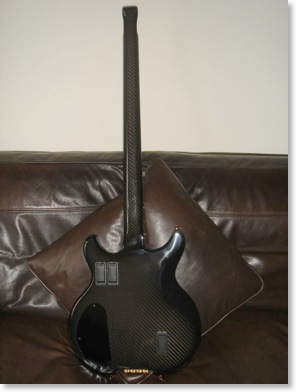
Here is a very good example of moo’s fretless Kingbass with moo wood facings. Custom wrap-around LED's... Custom carbon body with a wood facing. As far as we know it was the first one Rob produced and we don't actually think he's done another!

16. String gauge
Make sure you have a very good idea of your preferred string gauge and let Rob know so he can set up your bass accordingly!
17. Hard case
Status basses are all shipped in the regular size Hiscox case.
NB *If you can think of it, Rob can probably make it happen BUT please remember, every option takes time and therefore costs money!
And last but not least ... do not hesitate to visit us at www.statii.com or visit the Status-Graphite website at www.status-graphite.com